Loading...

Leather, a timeless material.

Play/Pause

Material

unchanged

over time

Eternal material

Leather has always accompanied the history of humankind. A primordial material—resistant, mutable, capable of transformation—it crosses the centuries yet resists time. “Eterna” is a journey into this continuity: traces, gestures, techniques, and symbols that link past, present, and future.

Prehistory

40,000 BC

Humans use animal hides to cover themselves, protect against the cold, and build rudimentary shelters. Early preservation techniques include drying, smoking, and the use of animal fats.

Ancient Era

3000 BC - 500 AD

Egyptians, Greeks and Romans develop primitive tanning techniques. Leather becomes a material for footwear, light armor, parchment, and tools.

The Middle Ages

5th - 14th century

Tanners’ guilds emerge in European cities. Vegetable tanning with tannins extracted from bark and leaves becomes widespread.

Renaissance

15th - 17th century

Leather is increasingly used for furnishings and luxury clothing. Florence and Venice become major centers for leather craftsmanship.

Industrial Revolution

18th - 19th century

The first leather-working machines are introduced. Chemical tanning (chrome tanning, 1858) revolutionizes the sector, making processes faster.

The Twentieth Century

Major fashion and luxury brands arise, using leather for bags, shoes, jackets, and accessories. Design embraces leather, making the material a symbol of status and elegance.

Today

21st century

Attention to sustainability grows. Luxury tanneries invest in green technologies, supply-chain traceability, and environmental certifications, focusing on quality, craftsmanship, and respect for the environment. Conceria del Corso is now an outstanding name in the leather trade. Like the leather it processes, it has evolved and innovated while preserving its authenticity and enhancing the quality of its products. Each manufacturing step is the result of research, expertise, and responsibility: certified processes, care and environmental awareness guarantee its value.

Created

avoiding

waste

And tomorrow?

Eternity is not stillness: it is the ability to regenerate. Leather is a material that weaves together history and innovation, evolving alongside increasingly sustainable technologies that reduce waste and enhance its practical value.

At the origins of leather in the Stone Age

The bone tools of the Contrebandiers Cave.

Along the Atlantic coast of Morocco, near Témara, lies the Contrebandiers Cave, a site that has yielded extraordinary evidence of early Homo sapiens life between 120,000 and 90,000 years ago. This period corresponds to the African Middle Stone Age, when humans were developing new technical and cultural abilities.

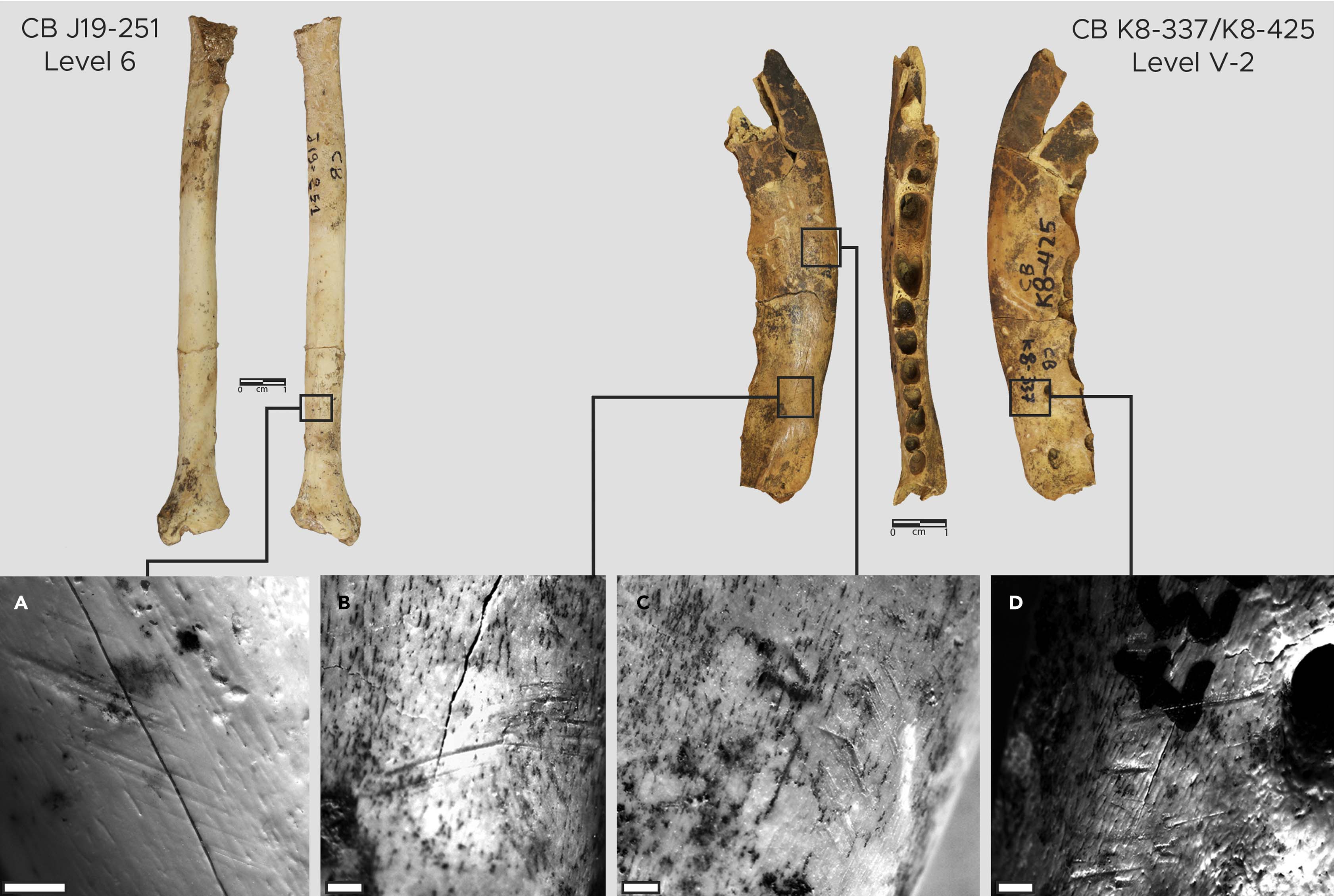
Archaeologist Hemily Hallet analyzed 62 carefully crafted bone tools found inside the cave. These were not random fragments but intentionally shaped, smoothed, and finished objects made for specific tasks. Among them stand out spatulas carved from animal ribs, whose form and surface are ideal for scraping and softening hides without piercing them. They represent one of the oldest direct testimonies of hide and fur processing.

Phases in the manufacture of bone spatulate tools.

The function of these tools is confirmed by faunal remains: the bones of small carnivores such as sand foxes, golden jackals, and wildcats show clear signs of skinning. The cut marks appear in precise areas—limbs, jaws, and around the head—exactly as in modern skin-removal techniques. Conversely, the bones of large herbivores such as bovids bear butchery marks related to meat consumption. This contrast shows that species were used differently: some for food, others for their pelts.

These findings represent some of the earliest archaeological clues to clothing in human history. We do not know exactly how garments were made, but the presence of specialized tools for hide preparation suggests that early sapiens were already wearing leather and fur clothing, allowing them to adapt better to different environments and climates.

Pressure-flaking tool made from a whale tooth.

The site also yielded other remarkable finds, such as the tip of a whale tooth dating to about 113,000 years ago, probably used as a pressure flaker to finish stone tools. Retouchers and other shaped bone tools complete the picture of a well-established technological tradition, not an isolated episode.

Skinned fox bones from the Contrebandiers Cave.

The cave shows that, already more than 100,000 years ago, North Africa had a complex material culture: early sapiens not only made stone tools but also systematically used bone and hide, anticipating behaviors that would become typical of our species. It is evidence that technological innovation was not a localized phenomenon, but a pan-African trend emerging very early in different human communities.

Sources:

Emily Y. Hallett, Curtis W. Marean, Teresa E. Steele, Esteban Álvarez-Fernández, Zenobia Jacobs, Jacopo Niccolò Cerasoni, Vera Aldeias, Eleanor M. L. Scerri, Deborah I. Olszewski, Mohamed Abdeljalil El Hajraoui, and Harold L. Dibble, A Worked Bone Assemblage from 120,000-90,000 Year Old Deposits at Contrebandiers Cave, Atlantic Coast, Morocco, iScience 24, no. 9 (2021): 102988, link.

Tutankhamun’s regalia

The king’s objects reveal the luxury and rituality of ancient Egypt.

When British archaeologist Howard Carter entered Tutankhamun’s tomb in 1922, he found an extraordinary burial assemblage, untouched for over three millennia. Among its treasures, he immediately noticed more than 130 staffs and maces, clear signs of their importance in royal life and power.

Many staffs featured the characteristic lotiform or papyriform shape, with ends shaped like lotus or papyrus flowers. These plants symbolized rebirth and the vitality of the Nile and were associated with deities such as Bastet and Hathor. Later, such staffs became widely used prestige and ritual items.

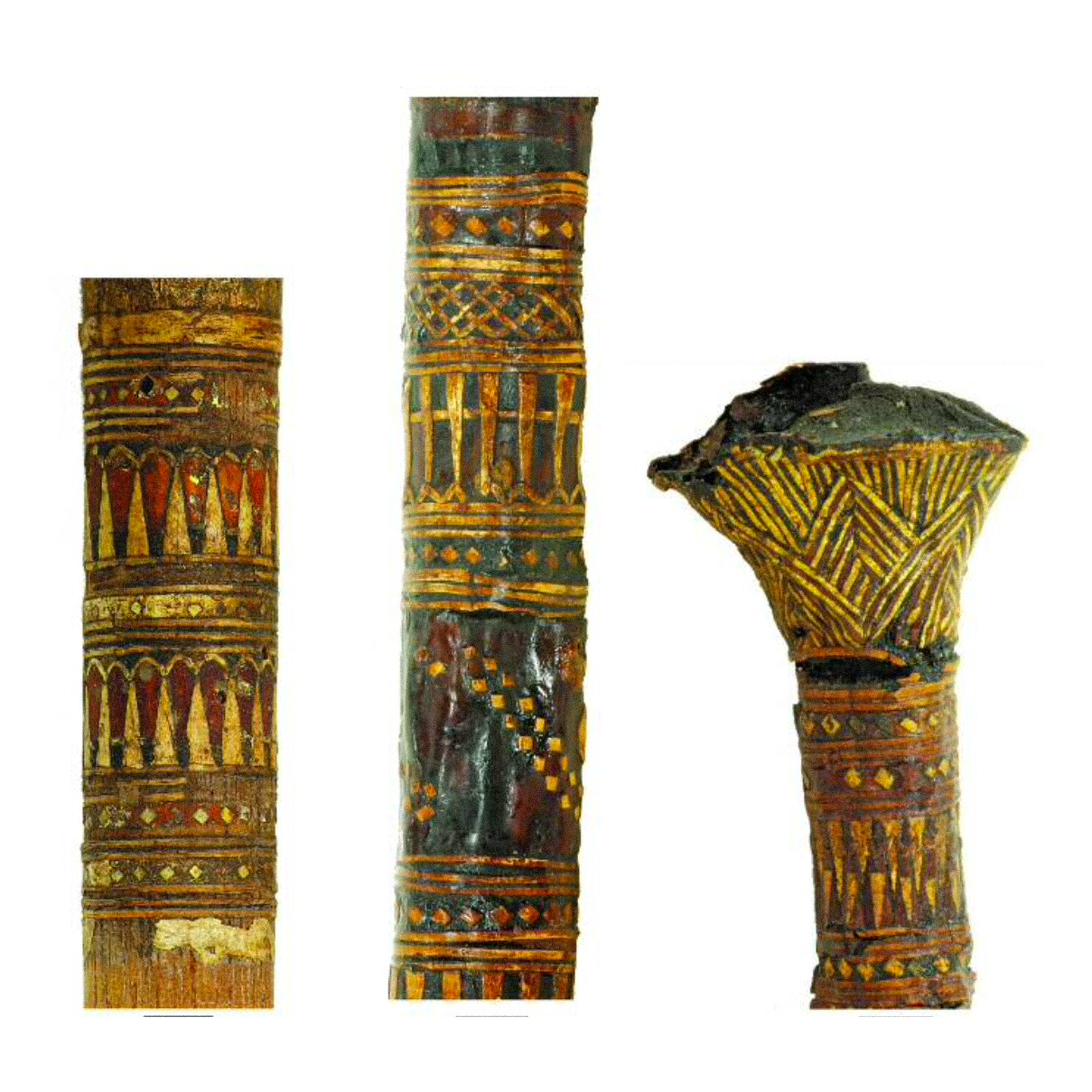
Three random examples of the complex appliqué decoration of lotus/papyrus-shaped staffs, including bark, leather, and gold leaf.

What makes Tutankhamun’s staffs unique is the variety of leather decorations—here leather is not merely a covering but an integral ornamental component. Alongside leather appear birch bark (sometimes reversed for different tones), gold leaf, and even thin beetle wings. Decorations form garlands, net and zig-zag patterns, concentric circles, and even short inscriptions. Often the base layer is green-dyed leather with small diamond-shaped inlays; elsewhere, tiny leather pieces precisely form garland leaves.

Technically, the staffs also reveal ingenuity. Pommel tops were not always carved from a single piece of wood: often they were made by wrapping leather strips around the shaft, fixed with animal glue, which provided a smooth, durable finish. Leather also added comfort and softness to the grip.

Despite their age, many details remain visible, though preserving leather has been challenging: humidity and organic decay have caused deterioration. Scholars believe most of the leather came from goat or sheep, with sturdier strips likely from cattle. The persistent presence of green coloring is striking, while the few red elements were not dyed leather but treated bark.

Now preserved in the Egyptian Museum in Cairo, these staffs reveal a lesser-known aspect of Tutankhamun’s reign: the central role of leather in the material culture of ancient Egypt—not only in clothing and footwear, but as luxury ornament and symbol of power, turning simple staffs into objects of prestige and ritual significance.

Sources:

André J. Veldmeijer and Salima Ikram, Leather Is Everywhere! Tutankhamun’s Sticks and Leather, Archaeological Leather Group Newsletter 51 (2020): 13-17.

Leather in Roman Italy

Techniques, facilities, and artisan knowledge made leather a strategic resource for the Empire.

In Roman Italy, leatherworking was fundamental, intertwining agriculture, trade, and urban life. Raw hides came largely from local livestock—especially in regions rich in cattle such as Apulia, Samnium, and Veneto—but high-quality hides were also imported from other provinces. Before processing, hides had to be preserved and transported: the most common methods were salting, which slowed decomposition by dehydration, and air-drying. Sometimes alum was used to stabilize hides. These techniques allowed long-term storage and long-distance shipping, with customs duties applied in ports specifically for hides and furs. Once delivered to workshops, hides underwent preliminary treatments: soaking to rehydrate them, scraping to remove tissue residues, and dehairing with lime or ash.

Rome, Santa Cecilia in Trastevere: domus with tannery.

Already in Roman times, a technique destined to shape centuries was spreading: vegetable tanning with tannins. Using bark and roots rich in tannins, hides became stable, resistant, and durable. The process was long but produced leather suited for armor, footwear, belts, accessories, and coverings. Finishing followed: smoothing with abrasive stones, oiling with fats to keep it flexible, and coloring with natural pigments.
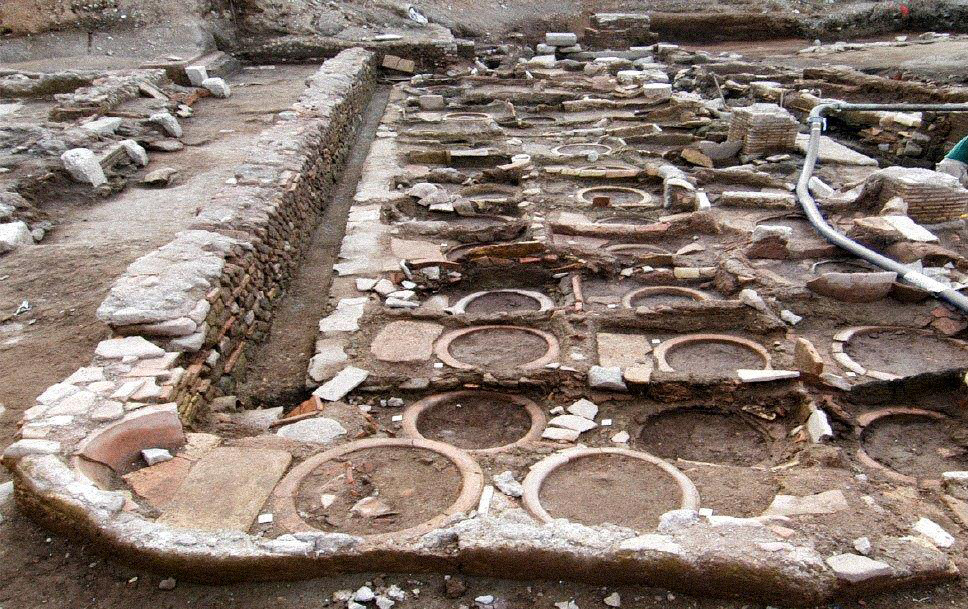
Rome, Casal Bertone: tanning vats.

Rome, Palazzo Leonori: details of tanning vats.

Such a complex cycle required specialized facilities. Tanneries had rectangular or conical vats, large washing containers, and drainage channels.

Sepino: plan of domus with tannery.

Sepino: tanning vats of the domus.

In some cases, such as Sepino, even watermills were used to grind bark for tanning—evidence of organized production and significant investment. Tanneries were not confined to city outskirts: in Pompeii, some houses were converted into tanneries; in Rome, Emperor Septimius Severus created the Coraria Septimiana district in Trastevere; in Milan, a whole tanning quarter developed.

Pompeii: tanning vats.

Even where facilities have not survived, telling traces remain: skinning bone waste, leather scraps, and amphorae that once contained alum. Far from being marginal figures, tanners played a central role in cities, supplying indispensable goods for daily life, the army, and even the imperial court. With the Empire’s decline (4th—5th century), many of these activities disappeared, and in several regions vegetable tanning traditions were lost. But for centuries, leather was a key material in Roman life, proof of a craft capable of transforming raw hide into a resistant, durable, essential material.

Sources:

Rosanna Goffredo, La manifattura del cuoio nell’Italia romana, Mélanges de l’École française de Rome - Antiquité 134, no. 1 (2022): 259-298, link.

The “Arte dei Cuoiai e dei Galigai”

The leatherworkers’ guild in medieval Florence.

Between the 12th and 13th centuries, Florence saw the rise of the Arti, the guilds that gathered artisans and workers of the same trade. In 1282 one of the most distinctive was founded: the Arte dei Cuoiai e dei Galigai, which brought together tanners (pelacani), leather merchants (pezzai), and artisans specializing in leather gilding (orpellai).

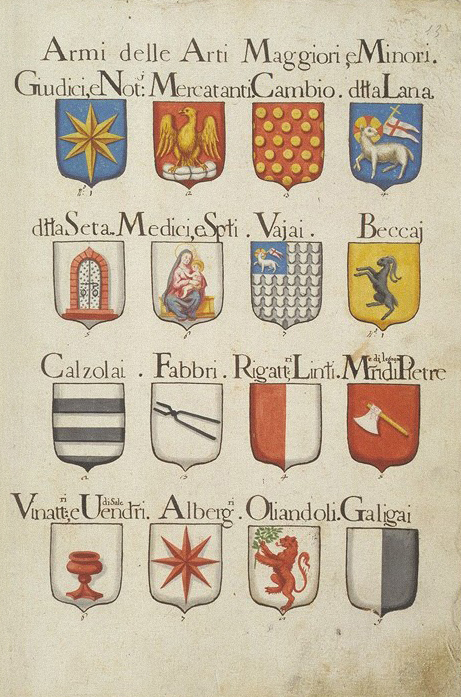
Coats of arms of the Florentine "Arti".

Tanning was essential but certainly not fragrant. At first it was practiced along the banks of the Arno, upstream and downstream from Ponte Vecchio, where hides were immersed and worked directly in the river. Due to strong odors, the activity was soon moved near Piazza Santa Croce. Although classified among the “minor arts”, the guild held significant influence, to the point that two streets were named after it (via delle Conce and via dei Conciatori) still present today.

The guild, ranked fourth among the minor arts, adopted a shield split into silver and black. Silver, one of heraldry’s two noble metals, symbolized light, air, purity, harmony, and faith; black represented mourning, seriousness, pain, but also inner strength and endurance. Their pairing expressed the dual nature of the trade, suspended between life and death: the tanner rescued animal skin from decay, giving it new life as a precious, durable material.

Sources:

Arteventi News, L’arte della concia delle pelli tra storia e made in Italy, August 8, 2020, link.

Soule: the medieval game born among leather tanners in Normandy

Between leather, tradition and rivalry, soule was the ancestor of modern football.

Long before stadiums and modern rules, football had an ancestor called soule, a medieval game born among leather tanners and villages in Normandy. Practiced from the 12th century (and likely earlier), it was a chaotic, rough, often violent mix of football and rugby.

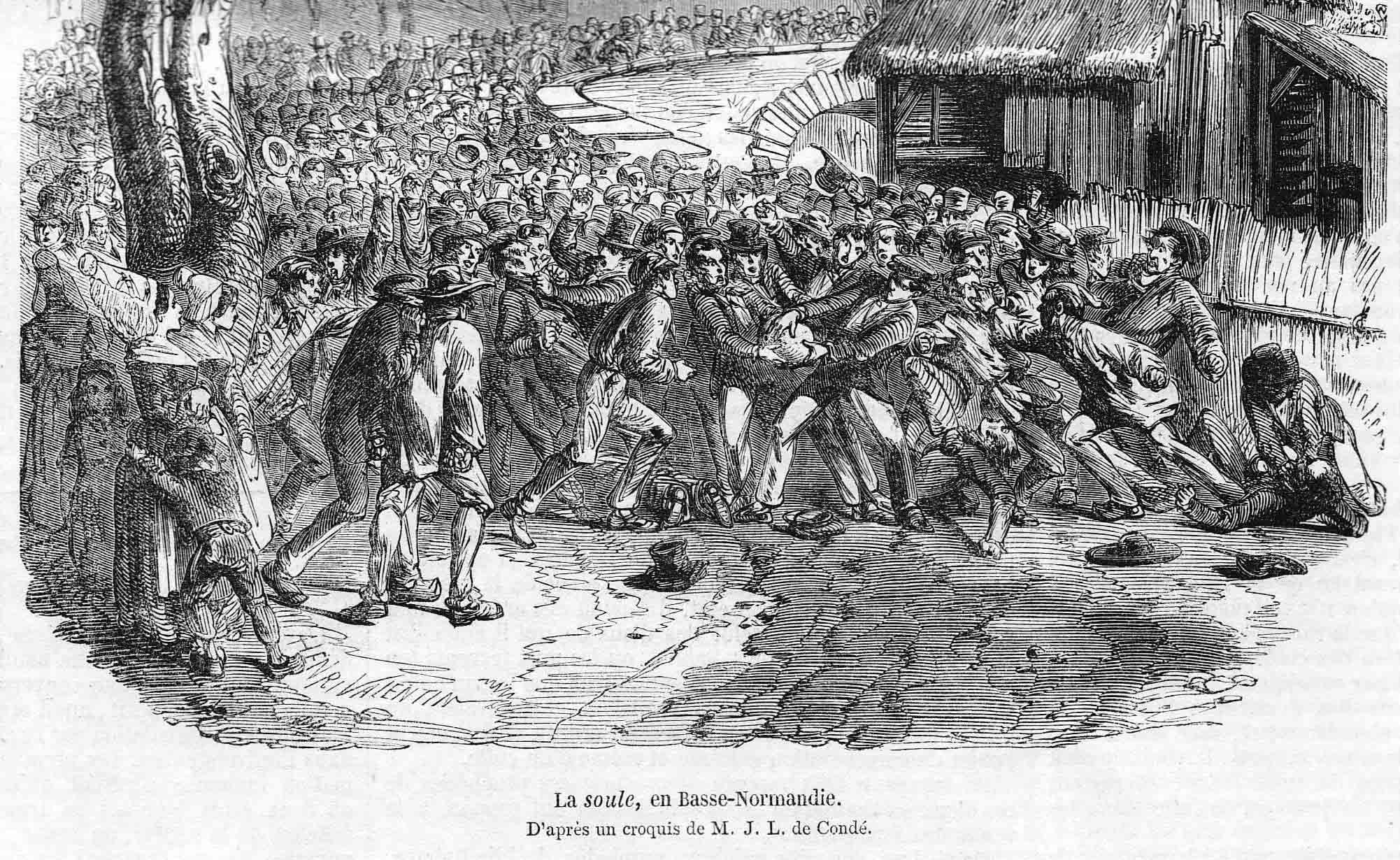
A soule match in Lower Normandy (detail from an 1852 engraving).

Soule was played mainly in rural areas with no limit to participants: entire villages competed, with teams of up to two hundred men. These festive battles took place during religious feasts, harvest celebrations, weddings, or births. The “field” could be the border between parishes, the village square, a churchyard, or even a cemetery; the “goal” was often the rival village center or a simple mark on the ground.

The ball was the heart of the game, made of leather or pig bladder, filled with bran, moss, hay, or horsehair. According to researcher Kevin Lognoné, the first true ball originated in the Norman town of Pont-Audemer, a thriving tanning center that used canal waters and oak bark for processing hides. Here, tanners may have been the first to transform their materials into a game ball.

Start of a soule match in Brittany, illustration from Breiz-Izel ou vie des Bretons de l’Armorique (19th century).

But soule was far from harmless: matches could last days and turn into harsh clashes. Broken noses, fractured bones, and even tragedies occurred—like the medieval account of forty men drowning during a match that ended in a marsh at Pont-l’Abbé. Neither royal bans (such as that by Charles V of France in 1365) nor threats of excommunication stopped it. Nobles, clergy, and commoners all took part, and the passion endured until the early 20th century in some rural communities.

Thus, from a wild game and a leather ball made by Norman tanners, the ancestor of modern football slowly took shape—today a sport that moves millions worldwide.

Sources:

Imparare con la Storia, Sport nel Medioevo: gli antenati del calcio, Text adapted from an article by Roberto Roveda, in collaboration with Francesca Saporiti, published in issue 221 of Medioevo - Un passato da riscoprire, June 2015, link.

La Conceria, Alle radici del calcio ci sarebbero la concia e un gioco medievale, December 12, 2020, link.

The “cuoi d'oro”: when leather became art and luxury between the Renaissance and the Baroque

From Venice to European courts, an ancient craft blending tanning, painting, and interior luxury.

The art of gilded leather (cuoi d’oro, or cuoridoro) flourished in Italy between the Renaissance and the Baroque, reaching its peak in the 17th century. Its origins date back to the 1400s, but the 16th-17th centuries saw its greatest splendor, and the 18th century its decline as tastes in interior décor changed.

Lodovico Carracci, The Chess Players, 1590.

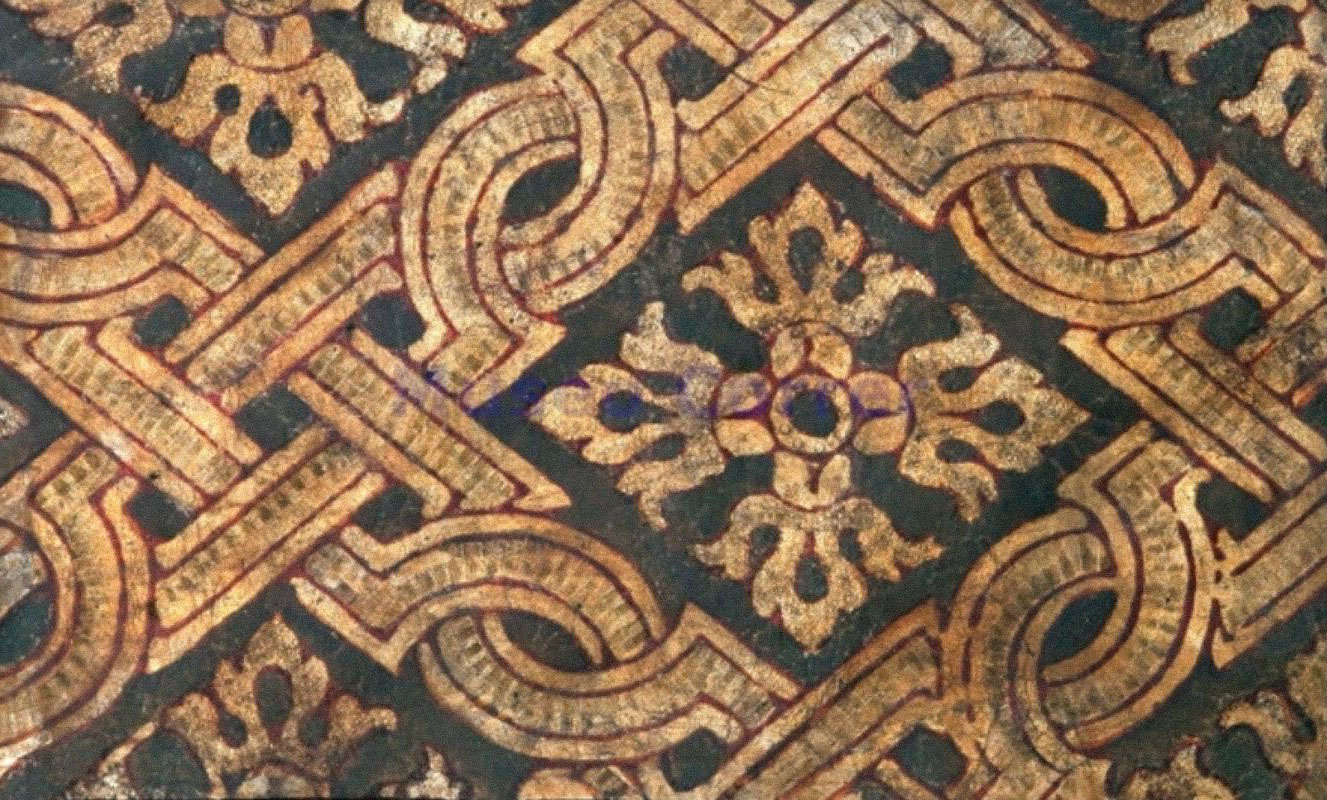
Gilded leathers transformed hide into shimmering surfaces: they served as wall coverings, furniture upholstery, sofas, chairs, bed backdrops, monumental door coverings, pelmets, and even clock casings. The secret lay in its multilayer technique: vegetable-tanned leather was covered with thin silver leaf, then coated with yellow varnishes made from aloe, turmeric, or saffron, giving it a golden sheen. The surface was then painted with enamels and pigments, sometimes embossed or stamped with geometric patterns. The result was a play of light and reflections that changed with illumination.

The technique’s origins were ancient, circulating between the East and Spain (the cordovan), but Venice became a major production center. Leather artisans, called scorzeri, had been organized into a guild since the 13th century. Because the craft produced strong odors, tanners were confined to the island of Giudecca. Specialists in gilded leather—the cuoridoro—belonged not to the tanners’ guild but to the painters’ and decorators’ guild (arte dei depentori), showing the artistic value of their work.

In the 16th century, about seventy workshops operated in Venice with considerable earnings. Their works adorned the palaces of major families—from the Gonzaga in Mantua and Ferrara to aristocratic residences in Spain and France. Even Ibrahim Bey of Constantinople commissioned them.

Gilded leathers at the Correr Museum.

Gilded leathers decorated not only noble residences but also offices, gaming houses, and private homes. Travelers such as Thomas Coryat (17th century) and Joseph Addison (18th century) described them with admiration, and painter Francesco Guardi included them in his works. Although production declined in the 18th century, Venice continued to produce high-quality pieces, such as the altar frontals of the Redentore Church and the thousand gilded leathers destined for Spain. Their final decline came with the abolition of guilds after the fall of the Venetian Republic in 1806.

Traces of this ancient craft remain. The cuoridoro had their workshops in the San Fantin area near the La Fenice Theatre; here survive the Calle and Palazzo del Cuoridoro. Examples also remain in the Doge’s Palace, Palazzo Papadopoli's library, Ca’ Vendramin Calergi, the Correr Museum, and a few other locations. The cuoridoro—a blend of tanning technique, painting, and luxury interior decoration—became one of the most recognizable signatures of Venetian taste between the Renaissance and the Baroque.

Sources:

Kurdyban, Ojcumiła Sieradzka-Malec (text), Agnieszka Kosakowska (introduction and photos), Dove cercare i cuoi d’oro se non a Venezia!, link.

Leather belts: the silent engine of the Industrial Revolution

For two centuries, leather transmitted energy to factories and mills, powering Britain’s growth.

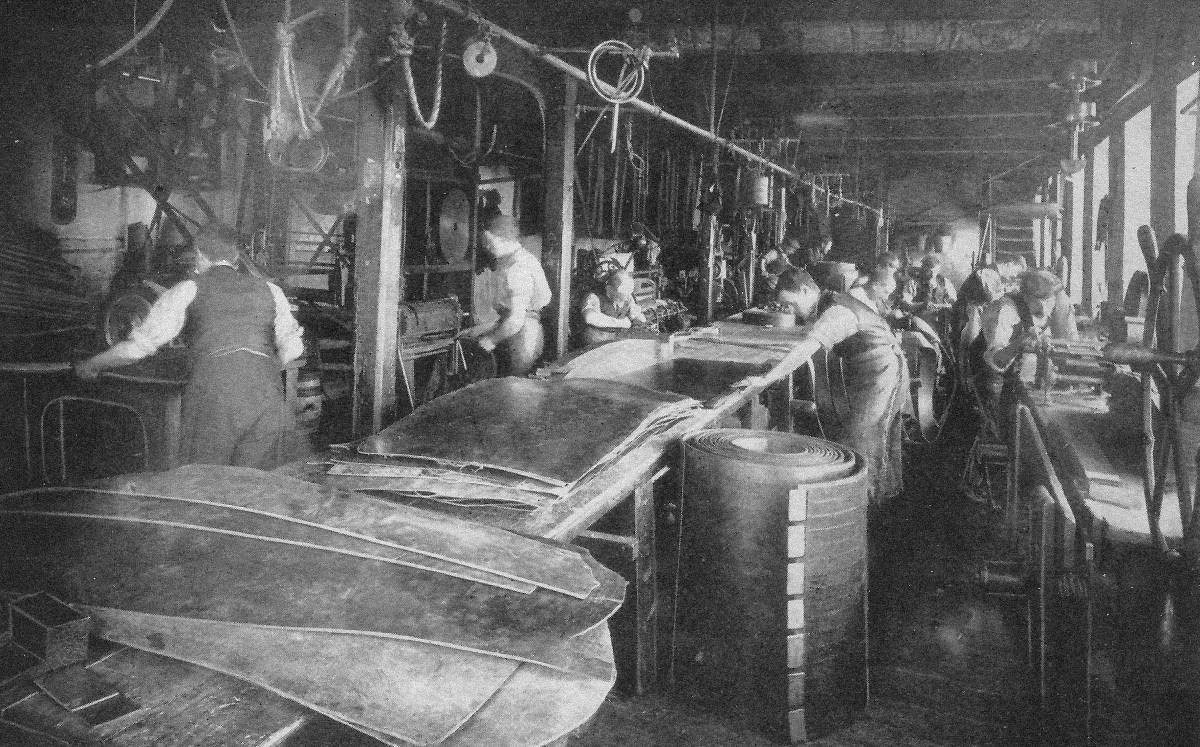
“There’s nothing like leather,” said an old English proverb. And indeed, for nearly two centuries, the strength of British industry relied on it. Before synthetic materials existed, leather transmission belts were the only way to transfer power from waterwheels, steam engines, and later electric motors to all sorts of machinery—from heavy industry to textile looms. Remarkably, these belts were used until the 1960s.

Inside the tanning shed of the Bolton Road tannery in Silsden.

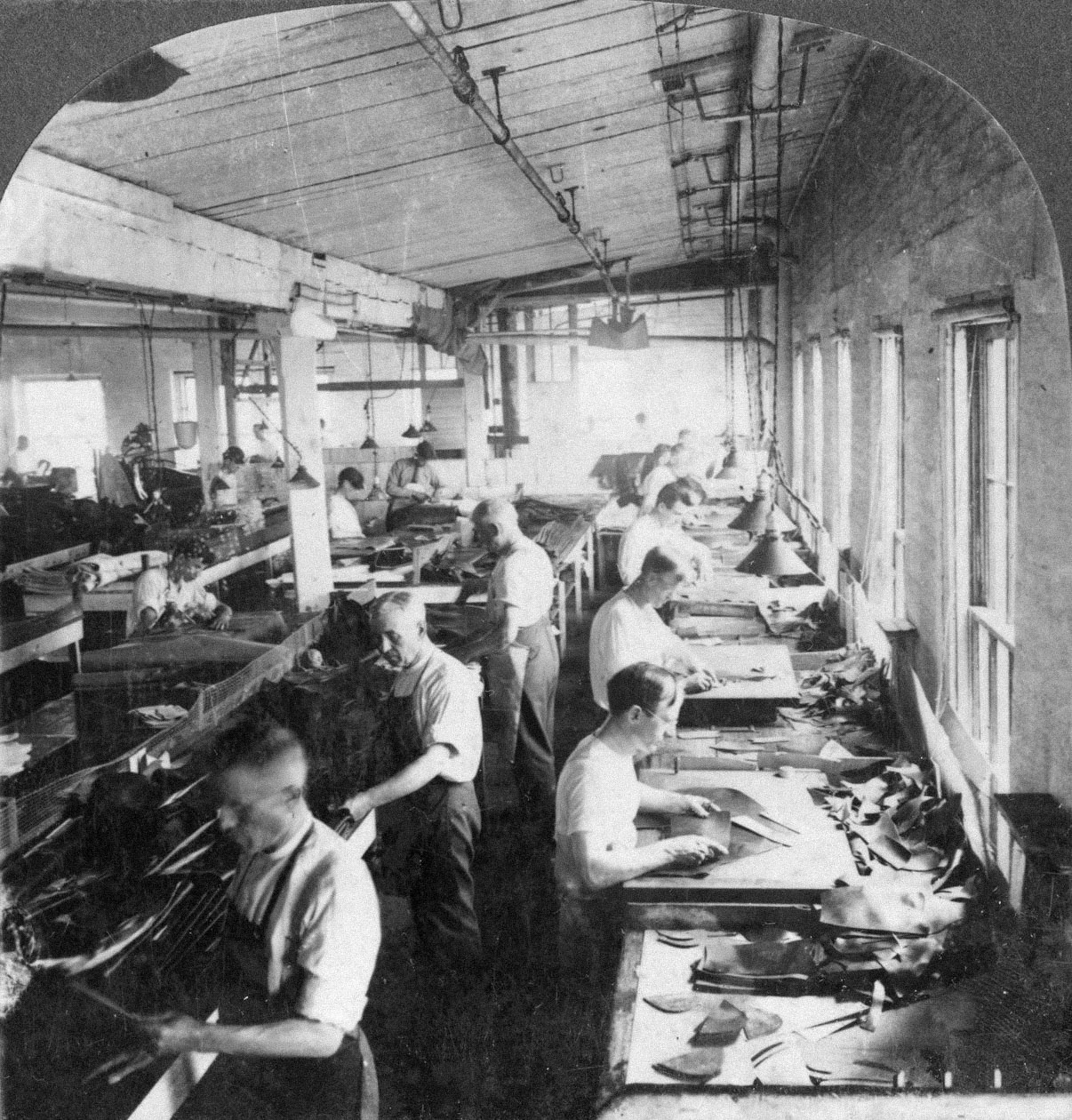
At the start of the Industrial Revolution, mills bought tanned hides and made their own belts. But as factories expanded, demand skyrocketed, and specialized manufacturers appeared. Keighley, in Yorkshire, became a key center: here tanners and curriers (finishers) turned almost exclusively to producing transmission belts.

The William Laycock & Sons shop at 35 Low Street, Keighley.

Three companies dominated the sector in the 19th—20th centuries: James & Thomas Whitehead, Isaac Foulds, and especially William Laycock & Sons (founded 1847). Initially buying pre-tanned hides, by 1890—with the large Bolton Road tannery at Silsden—Laycock managed the entire cycle: “taking raw hides from the butcher, tanning them the old way, finishing them, and supplying directly to customers.”

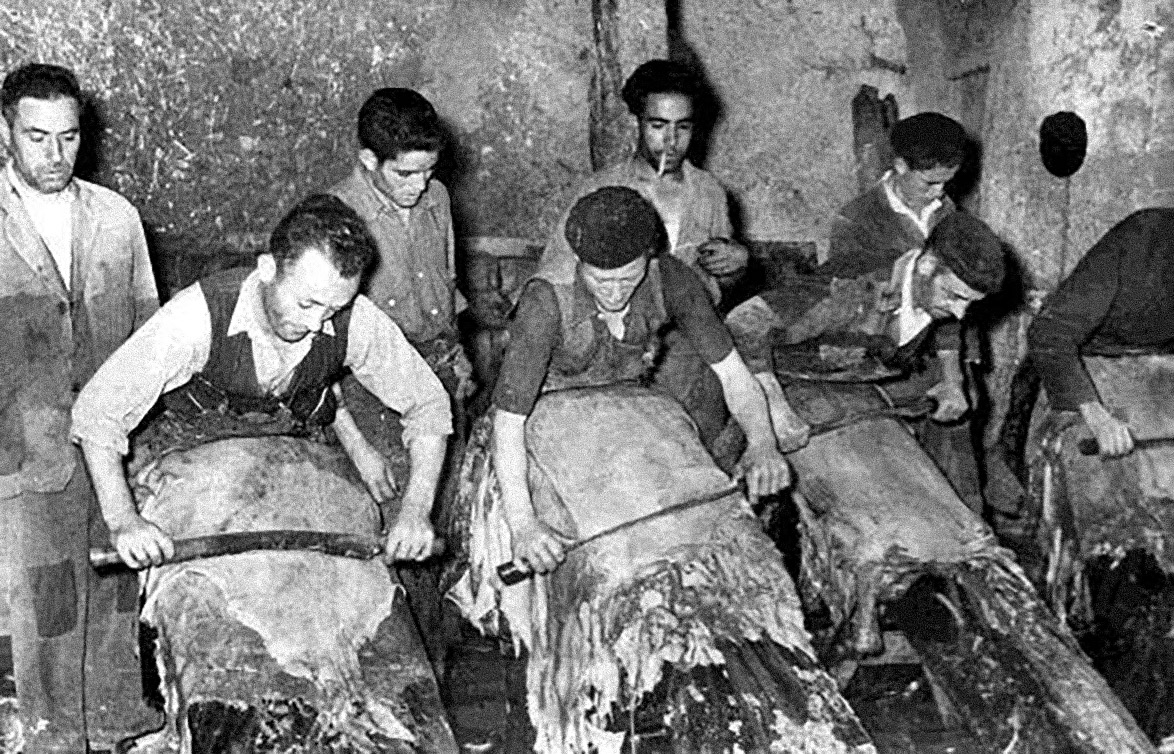
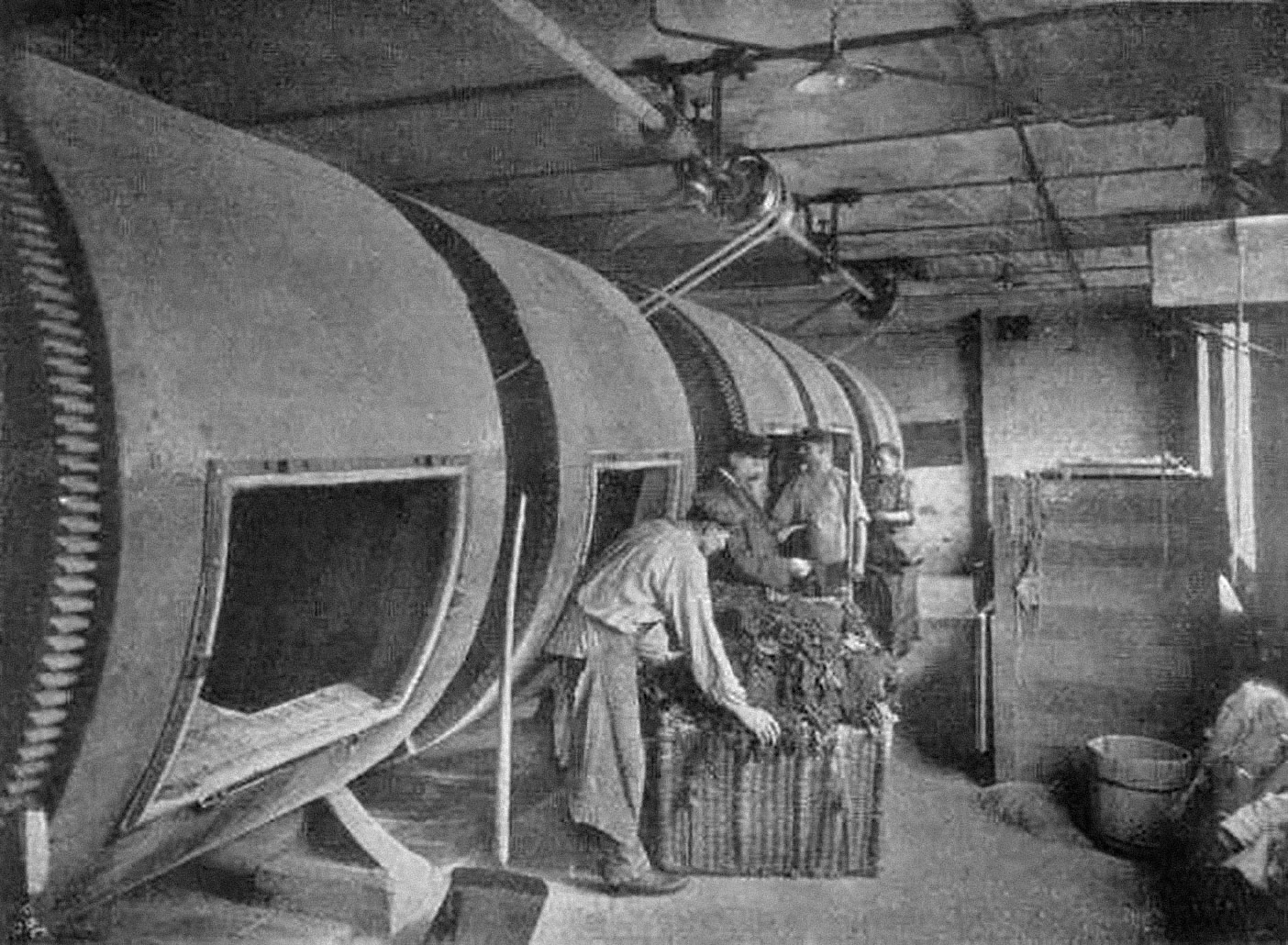
The process was long and meticulous: hides were soaked in lime pits, scraped with two-handled knives to remove hair and flesh, then cut and hung in tanning vats filled with water and oak bark. Once tanned, they became butts, which curriers treated with tallow and oils for softness and uniformity. From these came belts of various sizes: single belts for connecting machines to drive shafts; double-edged belts for transmitting power between shafts; and huge primary belts running from the power source to the main production line. Belts were cut along the backbone, cemented, stitched, and reinforced with waxed thread or copper.

Making double belts at Laycock’s Queen Street Works in Keighley.

Period catalogues tell remarkable stories: in 1902 at John Whittaker’s mill in Nelson, a belt 88 feet long and 32 inches wide had powered 1,270 looms for 16 years. At Holmes & Pearson Foundry in Keighley, a 168-foot belt had been running for 13 years and was “still perfect in every respect”.

The sector peaked in the mid-19th century and remained vital through the post-war era. In 1968, with the demolition of the Queen Street works, Laycock closed. Keighley’s historic firms merged into Charles Walker & Co., later absorbed by Habasit (UK), now a producer of synthetic belts for the food industry.

Thus, an ancient craft connected to tanning became the silent engine of the Industrial Revolution. For Keighley and British industry, that old saying was true: for two centuries, there really was nothing like leather.

Sources:

Alstair Shand, Memory Lane leather creates belting trade for Keighley’s firms, Keighley News, January 21, 2021, link.

La Conceria, Keighley (UK), dove la pelle innescò la Rivoluzione Industriale, January 30, 2021, link.

Marie Antoinette’s shoe

An 18th-century masterpiece of craftsmanship, symbol of elegance and historical memory.

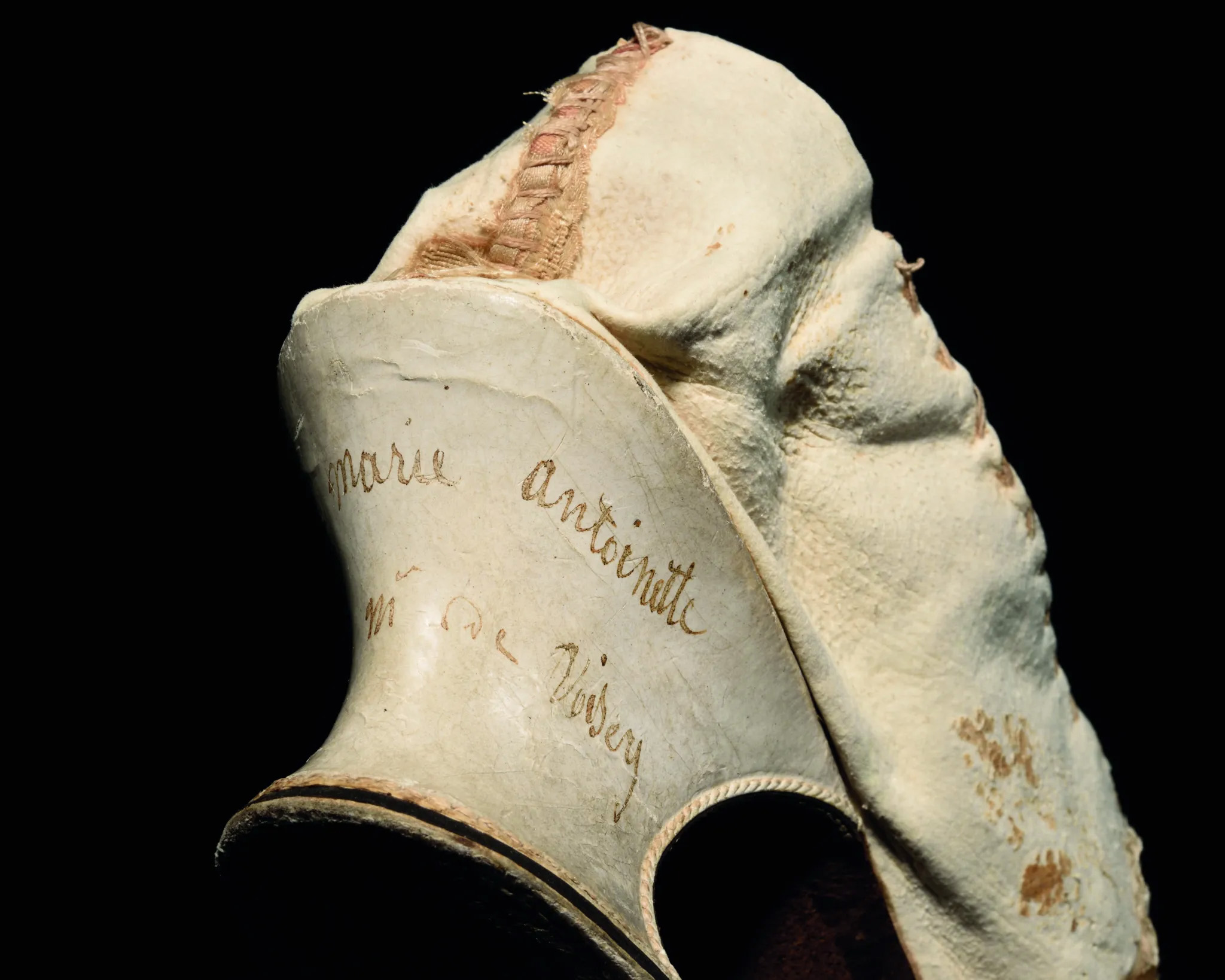
This elegant shoe belonged to Marie Antoinette of Habsburg-Lorraine, Queen of France and wife of Louis XVI—remembered not only for her tragic death at the guillotine in 1793, but also for her refined taste.

Made before 1789 by skilled leather artisans, the shoe combines silk with kidskin leather, featuring a leather sole. It measures 22.5 cm in length and has a 4.7 cm heel. Four layered pleated ribbons on the instep add a typically 18th-century touch of grace. More than a fashion item, it is a relic of history.

Its provenance is certain: it belonged to the de LaChapelle family. Charles Gilbert de LaChapelle, general commissioner of Versailles under Louis XVI, also played a role during the first revolutionary unrest: in 1791 he was entrusted with moving the relics of the Sainte-Chapelle to Saint-Denis. His fate was tragic, too: in 1794 he was guillotined. His wife, Marie Emilie Leschevin, was a close friend of Madame Campan, first lady-in-waiting to the queen, and it was likely through this relationship that the shoe reached the family.

On November 15, in Versailles, the Osenat auction house put the shoe back in the spotlight: estimated at €8,000—10,000, it was sold for a record €43,750 to a foreign private collector. A figure that confirms how every trace of France’s most debated queen continues to fascinate the world, turning a simple everyday object into a true relic of history and style.

Sources:

Laura Tortora, Maria Antonietta, all’asta le sue scarpe di seta, Vogue Italia, November 17, 2020, link.

La Chambre Bleue Paris, La scarpina di Maria Antonietta, La Chambre Bleue Cultura, il blog di Alessandra Giovanile e Virna Mejetta, November 25, 2020, link.